Posts By Minister Dr. Donald H. Garrett

Woe to (Some of) the Pharisees

This is from First Fruits of Zion. Everything written is their view and may or may not be the belief of Odon Obadyah Ministries.


Yeshua’s criticism of the Pharisees must be understood in concert with the Pharisees’ own self-critique; they were not really a gang of hypocrites.

While teaching in the Temple courts in the last days before He suffered, our Master warned His disciples about the pride, pretense, and hypocrisy of the scribes, Torah teachers, Pharisees, and religious leaders:

In His teaching He was saying: “Beware of the scribes who like to walk around in long robes, and like respectful greetings in the market places, and chief seats in the synagogues and places of honor at banquets, who devour widows’ houses, and for appearance’s sake offer long prayers; these will receive greater condemnation.” (Mark 12:38-40)

He criticized their love of honor and desire for prestige. They flaunted their religious apparel and loved to be greeted with respect in the markets. They took the seats of honor in the synagogues and at meals. They made long prayers to demonstrate their piety while neglecting the Torah’s weighty obligations, such as charity for the care of orphans and widows. Because they taught the Torah and presented themselves as holy men, they “will receive greater condemnation.” James, the brother of the Master, alluded to Yeshua’s warning when he wrote, “Let not many of you become teachers, my brethren, knowing that as such we will incur a stricter judgment” (James 3:1).

In Matthew 23:13-37, Yeshua pronounced seven “woes” upon the Pharisees. A parallel passage appears in Luke 11:39-54. The denouncements will convince most gospel readers unfamiliar with first-century Judaism that all Pharisees and rabbis were fairly awful human beings.

Increasing numbers of historians and Bible scholars have recently conceded that our Master did not condemn the Pharisees as a whole. Yeshua and His early disciples followed a form of Pharisaism. His theology, hermeneutic, parables, argumentation, conclusions, and even His dinner invitations were, for the most part, Pharisaic in origin.

How then do we understand the rancor with which Yeshua attacked the Pharisees in the Gospels? Yeshua’s scathing rebukes represent an internal criticism. Notice that He never offered similar rebukes to the Sadducees or the Herodians (even though they were far more wicked than the Pharisees). Neither did He condemn the Essenes, even though He did not endorse their theology or their withdrawal from the rest of the Jewish people. Because Yeshua’s own theology and practice ran so close to the Pharisees, the Pharisees fell under His immediate concern. In religious dialogue, we experience the fiercest conflict with those most similar to ourselves.

The writings of the Pharisees freely admit to the presence of rank hypocrisy and pretentiousness among some members of their sect. David Stern compiled and translated a fusion of passages from both Talmuds to illustrate this point. This internal criticism was written by disciples of the Pharisees themselves:

There are seven kinds of Pharisees: the “shoulder” Pharisee, who ostentatiously carried his good deeds on his shoulder so all can see them; the “wait-a-moment” Pharisee, who wants you to wait while he performs a mitzvah; the bruised Pharisee, who runs into a wall while looking at the ground to avoid seeing a woman; the “reckoning” Pharisee, who commits a sin, then does a good deed and balances the one against the other; the “pestle” Pharisee, whose head is bowed in false humility, like a pestle in a mortar; the Pharisee who asks, “What is my duty, so that I may do it?” as if he thought he had fulfilled every obligation already; the Pharisee from fear of the consequences if he doesn’t perform the commandments; and the Pharisee from love.

According to the Pharisees’ own evaluation, seven out of eight types of Pharisees were of an ignoble character. The Master’s criticism of the Pharisees should be understood in concert with the Pharisees’ own self-critique:

One should expose hypocrites to prevent the profanation of the Name. (Talmud)

Hypocrites will not stand before God. (Talmud)
 

No Bad Talk

Tzvi Freeman

Abraham’s Prayer

This is from First Fruits of Zion. Everything written is their view and may or may not be the belief of Odon Obadyah Ministries.


Sometimes, when you are praying about something for yourself, the best thing you can do is to forget about it and concentrate your prayers on the needs of others.

Abraham and Sarah in the Palace of Pharaoh, oil on canvas, by Peter Paul Rubens – Louvre MI 963 (Wikimedia Commons)

PORTION SUMMARY & SCRIPTURE READING
VAYERA

Abraham was one hundred years old. For all of his married life he had hoped for and prayed for the birth of a son, but Sarah, his wife, was barren. Her womb was closed.

Ironically, when Abraham’s enemy Abimelech abducted Abraham’s wife Sarah, God sealed the wombs of all Abimelech’s wives. Even those women who were about to give birth found that they could not bear their children. The Talmud says, “It was stated at the academy of Rabbi Yannai that even the hens belonging to Abimelech could not lay their eggs” (b.Bava Kama 92a quoting Genesis 20:18).

After Abimelech returned Sarah to Abraham, he asked Abraham to pray for him. Abraham prayed for the healing of Abimelech’s household. Rabbinic literature uses this episode from Abraham’s life as a model of forgiveness:

From where do we learn that an injured person who refuses to forgive his injurer (when he apologizes) is called a cruel person? From the words, “Abraham prayed to God, and God healed Abimelech…” (b.Bava Kama 92a)

Whoever is merciful to his fellow is certainly a son of our father Abraham, and whosoever is not merciful to his fellow is certainly not a son of our father Abraham. (b.Beitzah 32b)

Ironically, Abraham’s prayer availed children for Abimelech and his wives immediately. Furthermore, immediately after the Torah tells us that Abraham prayed for Abimelech’s wives—that their wombs would be opened—we read, “Then the LORD took note of Sarah as He had said, and the LORD did for Sarah as He had promised. So Sarah conceived and bore a son to Abraham in his old age…” (Genesis 21:1).

Not until Abraham prayed for others was his prayer for himself and his wife answered. Rashi says that the Torah put the passage regarding Abimelech’s wives just before the conception of and birth of Isaac intentionally. It is to teach us that whoever seeks mercy for another by praying for his need when he himself is needful of the same will have his own need met. At the very least, we learn here the principal of praying for others before ourselves.


Learn Religions origins of Halloween and Christmas

This is from Learn Religions. Everything written is their view and may or may not be the belief of Odon Obadyah Ministries.


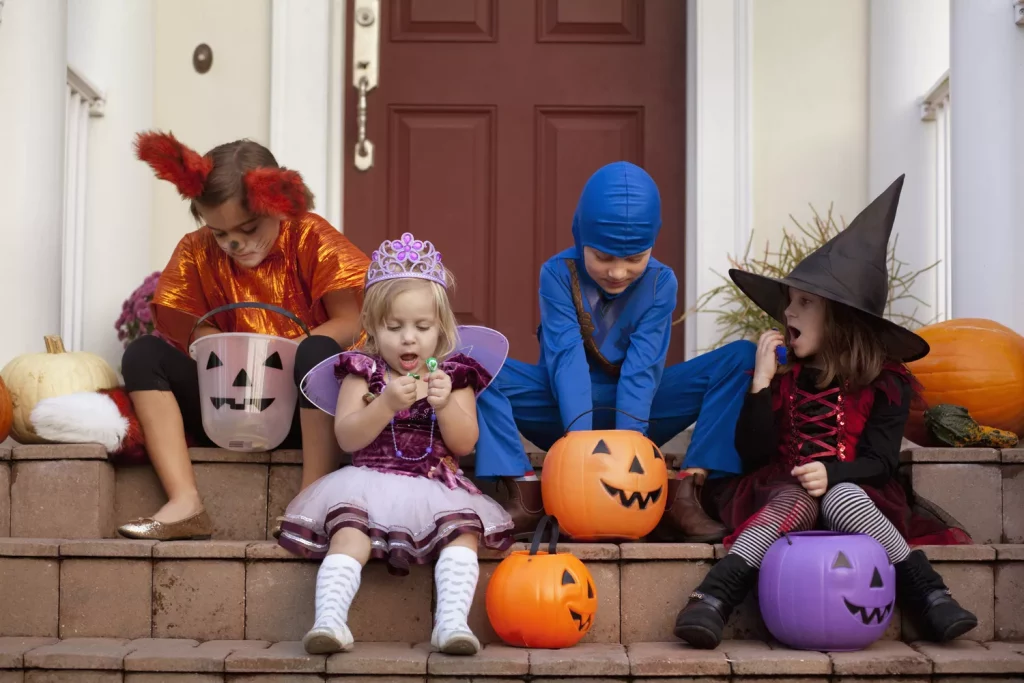
This image has an empty alt attribute; its file name is children-enjoying-treats-on-steps-551701795-57ab92315f9b58974a5b933b-1024x683.webp

Kinzie+Riehm / Getty Images
 
Table of Contents

Every year, a debate rages among Catholics and other Christians: Is Halloween a satanic holiday or merely a secular one? Should Catholic children dress up like ghosts and goblins, vampires and demons? Is it good for children to be scared? Lost in this debate is the history of Halloween, which, far from being a pagan religious event or a satanic holiday, is actually a Christian celebration that’s almost 1,300 years old. Is Halloween Catholic?


The Christian Origins of Halloween

Halloween is a name that means nothing by itself. It is a contraction of “All Hallows Eve,” and it designates the vigil of All Hallows Day, more commonly known today as All Saints Day. Hallow, as a noun, is an old English word for saint. As a verb, hallow means to make something holy or to honor it as holy. Both the feast of All Saints Day (November 1) and its vigil (October 31) have been celebrated since the early eighth century when they were instituted by Pope Gregory III in Rome. A century later, the feast and its vigil were extended to the Church at large by Pope Gregory IV. Today, All Saints Day is a Holy Day of Obligation. 


Does Halloween Have Pagan Origins?

Despite concerns among some Catholics and other Christians in recent years about the “pagan origins” of Halloween, there really are none. While Christians who are opposed to the celebration of Halloween frequently claim that it descends from the Celtic harvest festival of Samhain, the first attempts to show some connection between the vigil of All Saints and Samhain came over a thousand years after All Saints Day was named a universal feast. There’s no evidence whatsoever that Gregory III or Gregory IV was even aware of Samhain. The pagan festival had stopped being celebrated when the Celtic peoples converted to Christianity hundreds of years before the Feast of All Saints was instituted.


In Celtic peasant culture, however, elements of the harvest festival—shorn of their pagan roots—survived, even among Christians, just as the Christmas tree owes its origins to pre-Christian Germanic traditions without being a pagan ritual.


Combining the Celtic and the Christian

Some Celtic elements from Samhain that are still used at modern Halloween celebrations include lighting bonfires, carving turnips (and, in America, pumpkins), and going from house to house collecting treats, as carolers do at Christmas. But the supposed “occult” aspects of Halloween—ghosts and demons—actually have their roots in Catholic belief. Christians believed that, at certain times of the year (Christmas is another), the veil separating earth from Purgatory, Heaven, and even Hell becomes thinner, and the souls in Purgatory (ghosts) and demons can be more readily seen. Thus the tradition of Halloween costumes owes as much, if not more, to Christian belief as to Celtic tradition.


The (First) Anti-Catholic Attack on Halloween

The modern attacks on Halloween aren’t the first. In post-Reformation England, All Saints Day and its vigil were suppressed, and the Celtic peasant customs associated with Halloween were outlawed. Christmas and the traditions surrounding it were similarly attacked, and the Puritan Parliament banned Christmas outright in 1647. In the Northeastern United States, Puritans outlawed the celebration of both Christmas and Halloween. The celebration of Christmas in the United States was revived largely by German Catholic immigrants in the 19th century; Irish Catholic immigrants brought with them the celebration of Halloween. 


The Commercialization of Halloween

Continued opposition to Halloween in the late 19th century was largely an expression of anti-Catholicism and anti-Irish prejudice. But by the early 20th century, Halloween, like Christmas, was becoming highly commercialized. Pre-made costumes, decorations, and special candy all became widely available, and the Christian origins of the holiday were downplayed.


The rise of horror films, and especially the slasher films of the late 70’s and 80’s, contributed to Halloween’s bad reputation, as did the claims of Satanists and Wiccans, who created a mythology in which Halloween had once been their festival, co-opted later by Christians.


The (Second) Anti-Catholic Attack on Halloween

A new backlash against Halloween by non-Catholic Christians began in the 1980’s, in part because of claims that Halloween was the “Devil’s Night,” in part because of urban legends about poisons and razor blades in Halloween candy, and in part because of an explicit opposition to Catholicism. Jack Chick, a rabidly anti-Catholic fundamentalist who distributed Bible tracts in the form of small comic books, helped lead the charge.


By the late 1990s, many Catholic parents, unaware of the anti-Catholic origins of the attack on Halloween, had begun to question Halloween as well. Their concerns were elevated when, in 2009, an article from a British tabloid newspaper sparked an urban legend that Pope Benedict XVI had warned Catholics against celebrating Halloween. Even though there was no truth to the claim, alternative celebrations became popular and remain so to this day.


Alternatives to Halloween Activities

Ironically, one of the most popular Christian alternatives to celebrating Halloween is a secular “Harvest Festival,” which has more in common with the Celtic Samhain than it does with the Catholic All Saints Day. There’s nothing wrong with celebrating the harvest, but there’s no need to strip such a celebration of connections with the Christian liturgical calendar. It might be, for instance, be more appropriate to tie a celebration of the harvest to the fall Ember Days.


Another popular Catholic alternative is an All Saints Party, usually held on Halloween and featuring candy and costumes of saints rather than ghouls. At best, though, this is an attempt to Christianize an already Christian holiday.


Safety Concerns and the Fear Factor

Parents are in the best position to decide whether their children can participate safely in Halloween activities, and, in today’s world, it’s understandable that many choose to err on the side of caution. Scattered stories of poisoned apples and tampering with candy, which arose during the mid-1980s, left a residue of fear, even though they had been thoroughly debunked by 2002. One concern that’s often overblown, however, is the effect that fright might have on children. Some children, of course, are very sensitive, but most love scaring others and being scared themselves, within limits, of course. Any parent knows that the “Boo!” is usually followed by laughter, not only from the child doing the scaring but from the one being scared. Halloween provides a structured environment for fear.


Making Your Decision

In the end, the choice is yours to make as a parent. If you choose to let your children participate in Halloween, simply stress the need for physical safety, including checking over their candy when they return home, and explain the Christian origins of Halloween to your children. Before you send them off trick-or-treating, recite together the Prayer to Saint Michael the Archangel, and explain that, as Catholics, we believe in the reality of evil. Tie the vigil explicitly to the Feast of All Saints, and explain to your children why we celebrate that feast, so that they won’t view All Saints Day as “the boring day when we have to go to church before we can eat some more candy.”

Let’s reclaim Halloween for Christians, by returning to its roots in the Catholic Church!


Richert, Scott P. “Should Catholics Celebrate Halloween?” Learn Religions, Sep. 8, 2021, learnreligions.com/should-catholics-celebrate-halloween-542788.

Safety First

Halloween is a time most families celebrate with their children. It is not a Biblical holiday, yet it is not what some claim (worshiping the devil) either, except for those who already worship the devil. In other words, it is mostly a cute whimsical, fun celebration for most families with children. However, evil is out there. Decorations are placed outside to supposedly ward off this evil. Yet, only YaH and faith in Him can defeat evil. Instead of dressing your children up as things associated with evil, try dressing them up as nuns, angels, clowns, and such. 

There are vicious people out there who prey on children who are not properly supervised. If you are letting your children go out trick-or-treating for candy, please do not let them go alone and watch them very closely. It is easy to lose track of a child if there are other children wearing the same costume. 

  1. Make sure your child(ren) has your phone number available to tell someone in case they get lost.
  2. Place some kind of marker or identifier on their costume that is easy for you to identify from similar costumes.
  3. Maintain a close distance to your child where you can watch them.
  4. Do not allow your child to sample/eat the treats given to them until you have tested them for any foreign items or drugs.

As to the rest of you who do not have children you are taking around trick-or-treating, be cautious about what parties and people you associate with during this night. Keep your self in faith-based celebrations and activities. Watch out for any evil people or for anything that appears to be evil related. 

For the prayer warriors, get together and pray for all those who celebrate this holiday that they remain safe, evil does not come near them, and they are filled with joy instead of fear.

HalleluYaH and be safe.