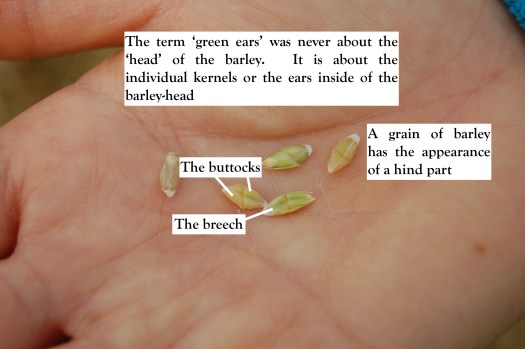
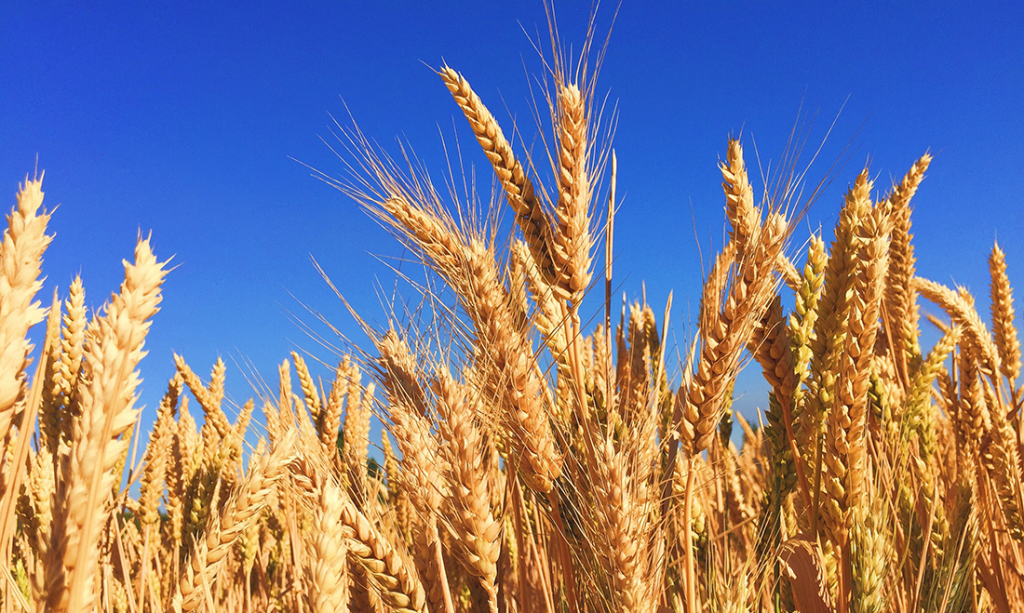
The definition for Aviv by Gesenius “green ear of corn”, Strong’s “to be tender”, Collegiate dictionary “fresh barley”. The people at insearchofhisancientpath.com have done an excellent study in the Old King James English to get a better picture. According to their conclusion (see picture above), the ear is the barley kernels and being green, fresh, or tender would mean it had just begun to develop and was not ripe for harvesting yet.
Today, the Jewish meaning of this word is simply “Spring”. Although not quite as descriptive as the green ears, it is comparable as the beginning of Spring is only the start of development of the plants.
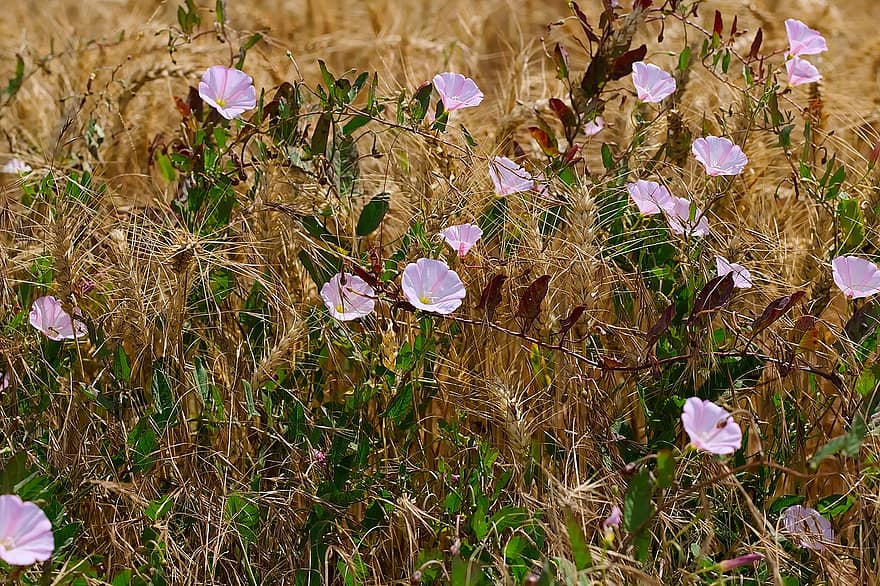
New flowering barley and binweed vine
Nisan
Nisan is later mentioned in the Bible replacing or complementing the name Abiyb as the first month. Nisan defined by Gesenius means “month of flowers.” Hebrew definitions list “to try, to attempt”. This still fits in with the above with new beginnings of the plants (see picture above).
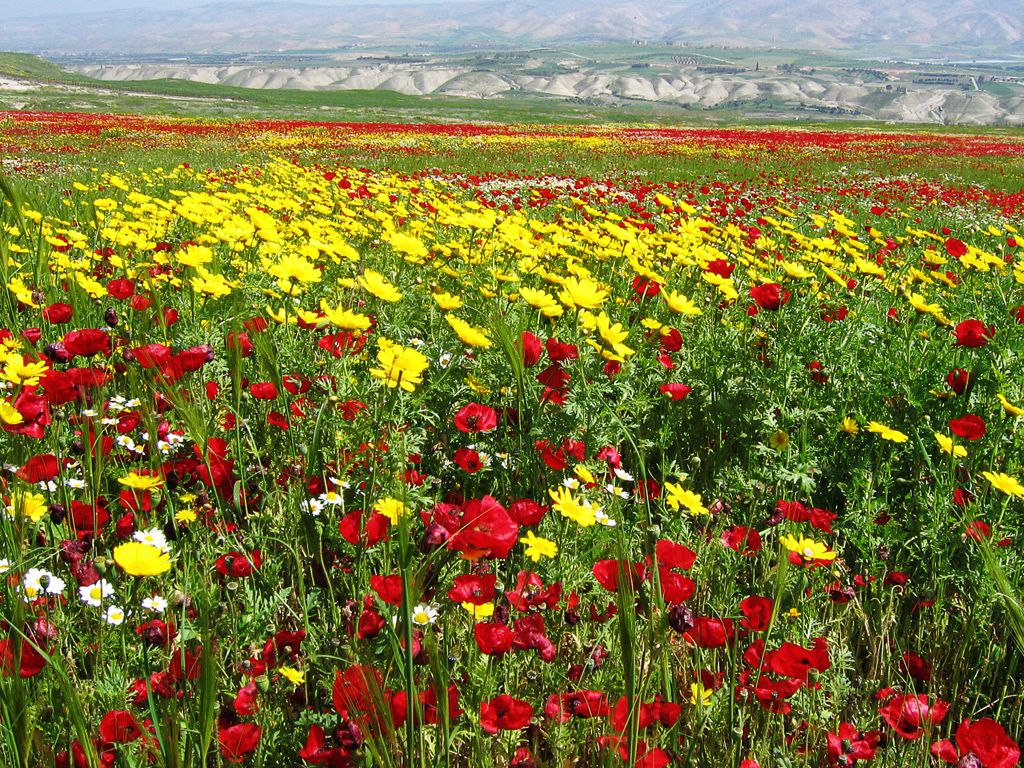
Ziv is defined by Gesenius “splendour [as of flowers]”, Strong’s “properly brightness, ie., the month of flowers”. This makes sense as the remaining flowers would be blooming in this month (see above picture).
Today, this month is referred to as IYAR אייר. The Hebrew organizations associate this with healing, though Google translates it to mean “air”. Iyar (Iyyar) is not used in the Bible.
Sivan is defined by Gesenius “from the root to rejoice, as the month of rejoicing”. This is still how this month is seen because of the festival of Shavuoth. This festival would have aligned with the harvesting of the barley and celebrating the bounty YaHVaH had provided. In the New Testament, this is the time of Pentecost, the giving of the Holy Spirit. This is a great time for celebration.
The fourth month is not mentioned by name in the Bible:
Tammuz
Tammuz is the current name for the fourth month counting Biblically, or tenth month by social/secular Hebrew calendar. According to numerous resources, this is the name of a heathen god from Syria or Babylon. One source says Hebrew women did lamentations during this month. Another says Tammuz is the god of fertility. With no mention in the Bible, there is no way to identify if any of this is correct.
Current Jewish thoughts agrees somewhat with the lamentations, as the 17th of Tammuz is a minor fast day beginning the 3 weeks of mourning over several historic events ending with the 9th of Av.
The definition for Av is simply “father”. All sources agree on this. In this month, both Temples were destroyed and many other tragedies occurred. Yet our Father in heaven is there to comfort and console us.
Elul is defined by Gesenius “vain”, Strong’s “related word ‘nothing'”, Collegiate Dictionary “harvest time.” Google translation is “might.” Current viewing of this month though sees it as a month of MERCY, and of weddings. It is the preparation month for the next month and a lot of Jewish people practice teshuvah at this time.
Eythaniym is defined by Gesenius “month of perennial streams” [A perennial stream or perennial river is a stream or river which has constant stream throughout the year through parts of its stream bed during years of normal rainfall. Wikipedia] (see photo above), Strong’s “the permanent brooks”. Google defines it as “stong, solid.” In this month are 3 very important Biblical days: Yom Teruah (Day of Blowing [shofar]), Yom Kippur (Day of Atonement), and the Feast/Festival of Sukkoth (Booths). Yom Teruah is a celebration day of blowing shofars and/or trumpets all day long. It initiates the 10 days of awe where most Jews prepare for the Day of Atonement. Yom Kippur is the most Holy Fast day in the Bible, where the priest would atone for the sins of the entire nation and everyone fasted and wept, some in sackcloth. Sukkoth is the Feast or Festival if you will, that celebrates another year of seeing YaHVaH’s grace upon the peope and the Fall harvest.
The current Jewish calendar (called social/secular on this site) changed the name of this month from Eythaniym to:
Tishri
Tishri (also called Tishrei) is not mentioned in the Bible. The current Jewish calendar uses this month to begin the Jewish New Year instead of the Biblical month of Aviv/Nisan. This month has the same 3 Holy Days since it still Eythaniym under a new name, but it changes Yom Teruah to Rosh Hashana (The New Year). The tradition of blowing the shofar and/or trumpet is still followed, but they add more to the celebration.
Bul is defined by Gesenius “rain, showers.” It is the 2nd Fall month, when all the rains come. The name fitting for the month.
Cheshvan
Cheshvan is the current name used to describe this month in the Jewish calendar. Cheshvan is the only month that does not have any holidays or special mitzvot. Google defines Cheshvan as “felt them.” How does this combine with rain? Anyway, the Jewish authorities still see it as a month of rain.
Kislev (or Chislev) is the ninth month on the Jewish calendar, counting from Nisan. It is best known for the holiday of Chanukah, which begins on 25 Kislev. The message of Chanukah is the eternal power of light over darkness—good over evil. There is no information on the definition of this word, only that it is of foreign origin.
There seems to be no definition or translation available. However, Chabad writes, “Its name, which is mentioned in the book of Esther, was acquired in Babylonia, and shares a root with the Hebrew word tov, meaning “good.”” Because the beginning of Teveth includes the ending of Chanukkah, the implication is the triumph of Good.
Shevat is defined by Gesenius “tribe (rod, sceptre, or staff)”. Google translates it as “year.” This month usually falls between ending January and beginning February, the coldest time of the year. The high point of the month is the holiday of 15 Shevat, known as the “New Year for Trees.” This is the day when the sap begins to rise in the fruit trees in Israel—the start of a new growing season. This coincides with most planting times before Spring in the horticultural realm.
The twelfth month (and thirteenth on leap years) in the Bible is:
Adar (on leap years it is Adar I and Adar II)
The definition by Gesenius “etymology is uncertain [other words seem to allude to greatness, magnificence]”, Strong’s “perhaps meaning fire”, and Collegiate Dictionary “to be dark”. Google translate it as “maple [tree].”
Chabad says:
“When Adar enters, joy increases,” the Talmud says. This reaches its climax on the 14th of the month, as we celebrate Mordechai and Esther’s triumph over the wicked Haman.
Well I celebrated my 58th birthday today, according to the Julian calendar.
However, as I looked up my birth according to the Hebrew calendar, I actually had a Hebrew birthday on the 9th of October. Amazing! 58 tens days earlier than I thought Ö
Begins sunset of Sunday, September 27, 2020 Ends nightfall of Monday, September 28, 2020
No work is permitted.
Yizkor is recited on Yom Kippur, Monday, September 28
Yom Kippur is the holiest day of the year—the day on which we are closest to G‑d and to the quintessence of our own souls. It is the Day of Atonement—“For on this day He will forgive you, to purify you, that you be cleansed from all your sins before G‑d” (Leviticus 16:30).
Many of us will be celebrating Yom Kippur alone for the very first time. Here are our pro tips to making your at-home Yom Kippur meaningful and memorable.
The seven days of Sukkot—celebrated by dwelling in the sukkah, taking the Four Kinds, and rejoicing—is the holiday when we expose ourselves to the elements in covered huts, commemorating G‑d’s sheltering our ancestors as they traveled from Egypt to the Promised Land. The Four Kinds express our unity and our belief in G‑d’s omnipresence. Coming after the solemn High Holidays, it is a time of joy and happiness
Moses on Mount Sinai, an oil-on-canvas painting by Jean-Léon Gérôme (1824–1904). (Image credit: Wikimedia Commons.)
The ‘Church’ at Mount Sinai
Moses returned from atop Mount Sinai, radiating the glory of God. As soon as he arrived in the camp, he “assembled all the congregation of the sons of Israel.” This Torah portion takes its name from the first Hebrew word of Exodus 35:1, “vaykhel.” The verb kahal (קהל) means “to assemble,” so vaykhel (ויקהל) means “and he assembled.”
The descent of Moses at the end of the previous Torah portion alludes to the second coming of the Messiah. Just as Moses assembled Israel at the time of his appearing, when Messiah comes again, He will gather together the assembly of Israel from the four corners of the world. Then the whole nation of Israel will be called the assembly of Messiah.
This concept helps us understand the meaning behind the New Testament word “church.”
As a noun, the Hebrew word kahal means “assembly,” “congregation,” or “community.” The Torah refers to the community of the tribes of Israel as the kahal, i.e., “the assembly,” a common Bible term denoting all Israel. The word kahal passes into the Greek Septuagint version of the Bible as ekklesia (ἐκκλησία). The Greek word ekklesia appears throughout the Greek version of the Old Testament to speak of the assembly of Israel or an assembly of worshippers in the Temple. However, when it occurs in the New Testament, English translators rarely render it as “assembly.” Inexplicably, English translators substitute the theologically charged term “church.”
The “church” translation of ekklesia has misled us. Because of the double standard in translation, it appears to most readers that “the church” first appeared in the New Testament, completely disconnected with the Old Testament and the nation of Israel. After all, the word “church” never appears before the book of Matthew. In reality, the word “church” does not appear in the Bible at all. By translating ekklesia as “church,” our English Bibles have led us to believe that “the church” is a new institution outside of Judaism and the Jewish people.
All of this information about the original languages implies that the New Testament church needs to be understood in continuity with the Jewish people, not as a disjuncture. In the broad sense, the church is the nation of Israel. The Messiah will gather all Israel into His assembly. In the narrow sense, the church is a subset of the larger assembly of Israel, consisting of believers who have identified Yeshua as the Messiah and cast their allegiance with Him.
Unfortuanetly, I have been neglectful in updating this website for August and September. I could blame this on my secular job’s demanding daily requirements, but that would only be partially correct as I have had some time off. Instead, I’ll just except that I have been very lax recently. Please forgive me in this as I go back to proper updating.