- Main Page
- Torah Readings
- Holiday & Monthly commentary from Min. Garrett
- Weekly drash from Jonathan
- Weekly parashah commentary from Min. Garrett
- Contact Us
- Membership
- Mission and Vision Statements
- Statements of Belief
- Books
- Articles by Min. Garrett
- Other Ministries
- Music Links
- Morning Prayers
- CAP/USAF News
- Jewish Calendar and Jewish History
Skip to content

Posts By Minister Dr. Donald H. Garrett
Shemini Atzeret
On October 6, 2023 0 Comments
- Time and Date
Often thought of as the eighth day of Sukkot, Shemini Atzeret is considered a time for Jewish people to renew their connection with divinity.
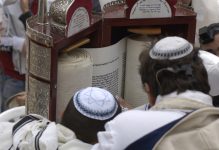 Shemini Atzeret marks a shift from the festivities of Sukkot to a more spiritual focus.
© iStockphoto.com/Alexander Donin
Is Shemini Atzeret a Public Holiday?
While this is not a public holiday in the United States, many Jewish-run organizations are closed on this date.
When Is Shemini Atzeret?
Shemi Atzeret is celebrated on the twenty-second day of the month of Tishrei in the Hebrew calendar, which usually falls between late September and early October in the Gregorian calendar. It is immediately followed by Simchat Torah.
To Tarry with the Divine
On the first night after the holiday of Sukkot, the opening blessing Shehecheyanu is recited, signaling the start of Shemini Atzeret, which is both a new holiday and one that is connected to Sukkot.
Drawn from the Hebrew words for “eighth” (Shemini) and “assembly” (Atzeret), the name of this holiday is also related to the idea of atzor, “a pause or tarry.” Many scholars of Judaism believe this to be a time for people to pause or tarry and spend more time with God after the seven days of Sukkot celebrations during the previous week.
Some rabbinic teachers explain the nature of this holiday with a parable of a king who calls in his sons to stay with him for some days. When the time comes for them to leave, he asks them to stay on for yet another day, since it is so difficult for him to part from them. Some see a metaphor in this for the relationship between God and the Jewish people.
A Just Rain
One feature of Shemini Atzeret is the prayer for rain and a good harvest that is traditionally recited as a reading from the torah scrolls on this date. Some scholars believe this tradition is related to the idea that Shimini Atzeret comes shortly after the Day of Atonement or Yom Kippur, so worshippers are asking for the gift of rain at a time when they are cleansed of sin.
In Talmudic literature, there is a concept that rain is metaphorical for God’s justice and this benevolence is meted out on the basis of worthiness. With this in mind, Seimini Atzeret is seen as the best time to pray for rain.
Jewish Holidays Last Longer Outside of Israel
In the Jewish diaspora—Jewish communities outside of Israel—an extra day is usually added to religious observances, with the exception of Yom Kippur, which lasts only one day worldwide, and Rosh Hashana, which is celebrated over two days in both Israel and the diaspora.
This custom has its roots in ancient times when the beginning of the months in the Jewish calendar still relied on the sighting of the crescent Moon following a New Moon.
The beginning of a new month was determined by the Sanhedrin, the supreme court of ancient Israel in Jerusalem. Once the date was published, messengers were dispatched to spread the news among Jews living abroad. Since this process took some time, it was decreed that Jews outside of ancient Israel were to observe every holiday for two days to make sure the rules and customs applicable to each holiday were observed on the proper date. This rule is still observed today.

Obeying Yom Kippur (Day of Atonement)
On September 23, 2023 0 Comments
- From the missions, Outreach Ministries
Leviticus 16:29-30
29. And shall remain unto you, an eternal statute, in the seventh month on the tenth of the month (Tishri 10), you shall humble your souls, and shall not do any work, neither the native nor the sojourner dwelling among you;
30. For on this day He shall provide atonement (purification) upon you to cleanse you, from all your sins before YAHVAH you shall be cleansed. Direct translation from the Hebrew text.
“Yom Kippur (the Day of Atonement) is the holiest day on the Jewish calendar, when we fast, pray, seek forgiveness from G-d and our fellows, and come closer to G-d. It is the peak of the High Holidays,” Chabad.org.
A time to reflect on our deeds, good or bad, and repent for the bad. A time to seek guidance from YAHVAH for a better life and future. A time to thank Him for all He has done for us.
Ten Things To Know About Rosh Hashanah
On September 15, 2023 0 Comments
- From the missions, Outreach Ministries
Ten Things To Know About Rosh Hashanah
by Outreach Minister, Virginia Garrett
1. Rosh Hashanah means “head of the year” in Hebrew. The holiday (according to Jewish tradition) occurs on the first day of the Hebrew month of Tishrei and is commonly referred to as the Jewish New Year. Tishrei falls in September or October. However, the true New Year starts on Abiyb (now called Nisan) 1st, which occurs in March or April. According to the Holy Scriptures (Ex. 12:2 and 13:4) referring to Abiyb (also called Nisan in Neh. 2:1 and Es. 3:7): “This month is to you a beginning of months, the first it is to you of the months of the year.” Ex. 12:2, ROSNV. “Today are ye coming forth, in the month Abiyb.” Ex. 13:4, ROSNV. See more at: rosh-hashanah
YaHVaH declared this and there is no mention of the date of the New Year being changed from Abiyb to Tishrei by YaHVaH.
2. Jewish tradition teaches that God created the Earth on the same date as the biblical Feast of Trumpets (Yom Teruah). For this reason, Rosh Hashanah and the Feast of Trumpets (Yom Teruah) are currently observed together.
3. Yom Teruah (which means Day of Blowing) is part of God’s instructions to Israel involving trumpet blowing. Today, Jewish people celebrate Creation and the start of a new year in synagogue services that include special liturgy, prayers and blessings along with 100 blasts of the shofar, the trumpet of the Bible made from a ram’s horn.
4. Rosh Hashanah ushers in the High Holy Days of the Jewish calendar. The Rabbis teach that at Rosh Hashanah, God pronounces a judgment for the coming year upon each of His people. On the Day of Atonement (Yom Kippur in Hebrew), He seals that judgment. The 10 days between these holy days are known as the Days of Awe. According to Jewish tradition, during this time, God may yet alter what was to be an unfavorable decree and grant a good new year. Therefore, Rosh Hashanah begins a time of intense reflection on one’s life and repentance before God in preparation for Yom Kippur (Day of Atonement).
5. A traditional holiday greeting for Rosh Hashanah is Shanah Tovah Umetukah, which means “A good and sweet year!” This is sometimes shortened to simply L’shana Tovah!, meaning “For a good year!”
6. Rosh Hashanah is a rest day, in which God forbids all regular work.
7. Currently, Rosh Hashanah has come to be celebrated on two days. With a calendar system that changed months based on the lunar cycle, the first of a new month wasn’t known until the new moon sighting was reported. A month could have 29 or 30 days, depending on the new moon to signal the start of the next month. Reports could take well into what was supposed to be a rest day. Jewish people in the Diaspora took much longer to learn of the new month’s arrival. So, the religious leaders declared both the day of waiting for the report and the following day as sanctified for observing the holy day.
8. Challah is the special, braided bread of Shabbat. Typically, challah bread is braided in a traditional loaf shape. On Rosh Hashanah, we shape the braided dough into a round loaf to symbolize the cyclical nature of one year leading into another. Some also consider it symbolic of a crown, highlighting our commitment to crown the Lord as King of our lives.
9. The most traditional food associated with Rosh Hashanah is honey. The sweetness symbolizes the hope of a sweet new year. Apples dipped in honey and honey cakes are customary treats.
10. Messianic Jewish Believers celebrate Rosh Hashanah/Yom Teruah with an additional spiritual element in mind. Like the other Feasts God commanded of Israel, Yom Teruah contains a prophetic picture of what God would do in the future as His redemptive plan unfolded through the Messiah, Yeshua. The Bible says little about Yom Teruah. Yet, with the emphasis on blowing the shofar, we can easily see an End-Time correlation to the prophesied last trumpet (1 Corinthians 15:51–52). Yom Teruah is often associated with the initiation of the Messianic Age and the resurrection of the dead in Messiah, though Rosh Hashanah is not.
From the President, Min. Donald H. Garrett:
It is my belief that celebrating Rosh Hashanah on Yom Teruah takes away from the meaning and importance of Yom Teruah. Yom Teruah is meant to be a day of warning and attention getting to the people to prepare for the upcomping Yom Kippur (Day of Atonement). However, today the day is celebrated as Rosh Hashanah with laughter and joy; the exact opposite of YaHVaH’s meaning for this day. I challenge ALL to decide for yourselves whether it is appropriate. May YaHVaH bless you.
Redeemer
On September 8, 2023 0 Comments
- From the missions, Outreach Ministries
Redeemer
Exodus 15:13
In your loving kindness, you have led the people whom you have redeemed in your strength you have guided them to your holy habitation
Philippians 1:6
Being persuaded of this very thing, that He Who has begun in you, a good work will perfect it until the day of Yeshua , the Messiah.
The dictionary defines redemption as the action of saving or being saved from sin, error, or evil, and the action of big, gaining in exchange for payment, or clearing the death debt.
Redemption involves deliverance from bondage, based on the payment of a price for a redeemer. Fundamental to the message of the New Testament is the announcement that Yeshua of Nazareth IS the fulfillment of Israel’s messianic hope and that, in Him, the long awaited redemption has arrived. Deliverance of humankind from its state of alienation from Hashem has been accomplished through the death and resurrection of Yeshua.
Living in a fallen world, as believers means, we will experience trials and tribulations, and will continue to struggle with our own Temptations. We are forgiven, but Hashem is not finished with us yet.
Consequently, longing for a better world even, a perfect world, is not a form of escapism, rather, it is the believers rightful anticipation of a promise made by the One Who justly pronounced a curse on this world, and then lovingly took the curse upon Himself in order to redeem people for His glory.
The Lion of Yehudah (Judah)
On August 25, 2023 0 Comments
- From the missions, Outreach Ministries
The Lion of Yehudah
Hebrews 7:12-16
12. For the priesthood being changed, it is of necessity, a change also of the Torah.
13. For He as to Whom these things are spoken, pertaineth to a different tribe, from which no man hath given attendance at the altar;
14. For it is very evident that hath sprung out of Yehudah our Lord, wherein which tribe Mosheh spoke nothing of concerning priesthood,
15. And yet more abundantly evident it is, that according to the likeness of Malchiy’tzedek, there is to be raised up a different priest.
16. Who is made, for not of a law of commandment with the flesh, but according to the power “of an endless life” (we will be judged, actual translation of hebrew word nip’sakiym shown in the New Testament by the Hope of Israel, which is different from “of an endless life” in the English translations);
17. For He testifieth, You art a priest forever after the order of Malchiy’Tzedek (Melchisedek in English).
That ’change’ was our Messiah! YES! And what better choice. Born of the house of Yehudah, NOT a priestly family of Aharon, but of Melchisedek. To come from somewhere unexpectedly! He came as an unknown; humble and pure. Sharing the words of YAHVAH with love to ALL mankind. He WAS the purest sacrificial lamb and because of His great sacrifice we now have eternal life. He is with us always; in our hearts and our thoughts but… is He coming by the power of endless life; Or by His power we will be judged?
He will return as the Lion to devour all evil and cleanse the land…
The Lion of Yehudah
We support the Armed Forces of the US and Israel


 Friends of the Israel Defense Forces
 American Friends of Our Armed Forces